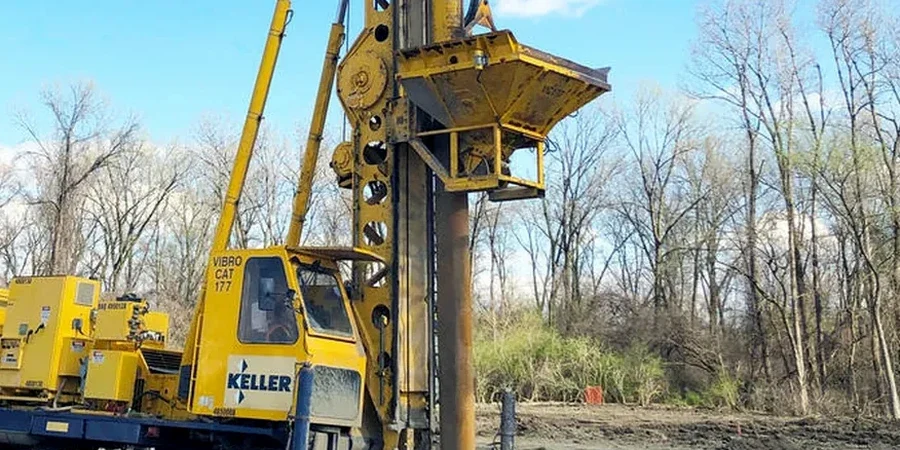
The biggest mistake we see on Thunder Bay job sites is treating the local silty sand like it's standard Ontario fill. It isn't. The city sits on the bed of glacial Lake Agassiz, leaving behind sequences of loose, saturated sediments that are notoriously unstable. You bring in a standard compactor, run passes all day, and the ground still bounces like a waterbed. That's where stone columns come to mind for many, but for liquefiable free-draining sands, deep vibrocompaction design delivers a far more cost-effective solution. Our team has tackled these varved deposits from Current River to the Intercity area, and we know that getting the grid spacing right is the difference between a solid warehouse slab and a costly post-construction settlement claim.
In Thunder Bay's water-charged basin soils, vibrocompaction isn't just about reaching 70% relative density—it's about holding it while the water table fluctuates through spring melt.
Site-specific factors
With a population of over 108,000 and growing industrial traffic along the Trans-Canada corridor, Thunder Bay can't afford foundation failures on its logistics hubs. The last serious seismic reminder here was the 2010 Val-des-Bois event, felt across Ontario, which rattled complacency about intraplate earthquakes in the Shield margin. Loose, saturated sands in the Intercity area are textbook candidates for seismic-induced settlement or even limited lateral spreading. If you skip a proper vibrocompaction design and just rely on shallow compaction, the structure might survive the shaking but the differential settlement will tear apart slab joints and rack steel frames. We've remediated enough of those to know the upfront cost of densification is a fraction of the post-occupancy repair bill.
Common questions
What kind of soils in Thunder Bay respond best to vibrocompaction?
Clean, free-draining sands and gravelly sands with less than about 15% fines. The glaciofluvial deposits near the Neebing River often fit this profile. If the fines content is higher, we may need to look at stone columns or grouting instead.
How deep can you compact with this method?
We routinely design for depths up to 30 meters. In the basin areas south of Victoria Avenue, the loose zone typically bottoms out around 18 to 22 meters, which is well within our equipment's reach.
Is vibrocompaction loud or disruptive?
It's a vibration-intensive process, yes. We coordinate with adjacent property owners and measure peak particle velocity to stay within safe limits. For sensitive structures nearby, we adjust the frequency or use pre-drilling to decouple the vibration.
What does vibrocompaction design cost in Thunder Bay?
Depending on depth, grid spacing, and access, a design-build package can range from CA$2,070 to CA$7,490 for a typical commercial lot. The biggest variable is the depth of the loose layer and the number of probe points needed to meet the target density.