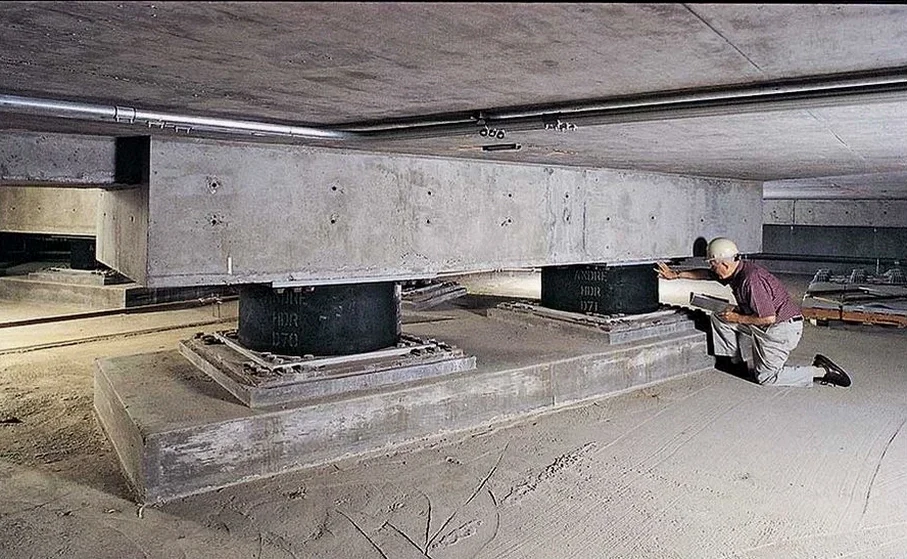
Designing for seismic resilience in Thunder Bay means accounting for the distinct geological contrast between the dense, compact till overlying the Precambrian Shield on the city's elevated terraces and the softer, water-laden silts and clays found near the floodplains of the Kaministiquia River. A structure anchored in the Intercity area, sitting on shallow bedrock, interacts with ground motion very differently than one in Port Arthur's lower-lying zones, where deeper soil columns can amplify seismic waves. Base isolation seismic design addresses these disparities by decoupling the superstructure from the ground, a strategy that becomes particularly relevant when evaluating the moderate yet persistent seismicity associated with the ancient Midcontinent Rift system beneath Lake Superior. This approach, which relies on a detailed seismic microzonation study to characterize site-specific response spectra, allows us to move beyond conventional force-based methods and target predictable structural performance even under the Maximum Considered Earthquake.
Effective isolation design in the Lake Superior basin requires shifting the structural period beyond 2.5 seconds to avoid amplification from soft clay sites.
Site-specific factors
The specialized hardware required for a base isolation system in Thunder Bay demands a level of manufacturing precision and installation oversight that goes far beyond standard construction trades—the high-damping rubber bearings, often over 800 mm in diameter, are fabricated in controlled environments and must be positioned on lower pedestals with a flatness tolerance of ±2 mm over the plan area to prevent unintended rocking under lateral load. The greater risk lies not in the isolated components themselves, however, but in the interface detailing: a non-structural element like a rigidly connected entrance ramp, a gas line crossing the isolation plane, or an undersized moat cover can inadvertently lock the isolation system, transferring full seismic forces into a structure designed for drastically reduced accelerations. Our construction-phase oversight therefore focuses relentlessly on the isolation plane clearance, verifying that all horizontal utilities incorporate flexible loops rated for triaxial displacement and that the perimeter moat wall is dimensioned for the total maximum displacement vector calculated from the near-fault pulse characteristics embedded in the regional seismicity model.
Common questions
What is the typical cost range for a base isolation seismic design study for a medium-sized building in Thunder Bay?
For a comprehensive design package—including site-specific hazard analysis, nonlinear modeling, bearing specification, and construction drawings—the investment generally ranges from CA$5,830 to CA$11,470, depending on structural complexity and the number of unique isolator types required. An initial scoping meeting will establish the precise scope.
How does the moderate seismicity of Thunder Bay justify the investment in base isolation instead of conventional ductile design?
The reference range for this service in Thunder Bay is CA$5.830 - CA$11.470. The final price depends on the project scope and volume.
What geotechnical parameters are essential before starting the isolation design?
We require a site-specific shear wave velocity profile to a depth of at least 30 metres, soil plasticity and consolidation characteristics to rule out dynamic settlement, and the Site Class designation per NBCC Table 4.1.8.4.A. A geophysical survey like MASW is typically the starting point for developing this dataset.