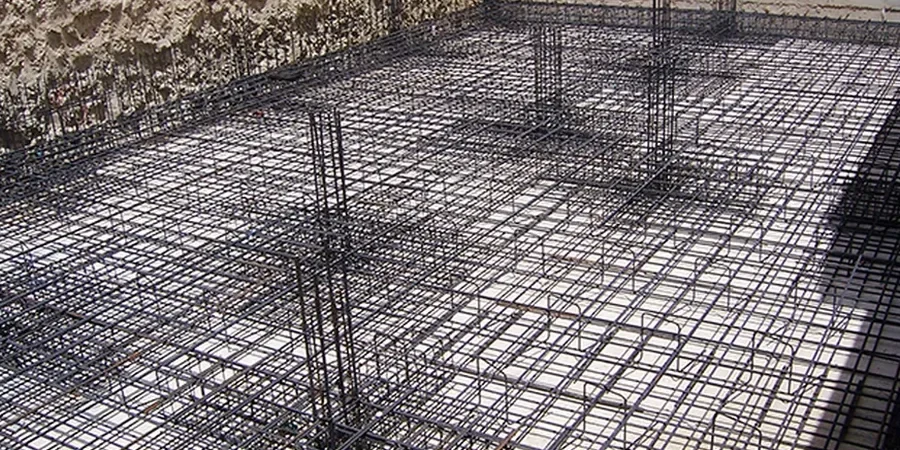
In Thunder Bay, the legacy of Glacial Lake Agassiz left behind a complex sequence of glaciolacustrine clays and silts that can extend over 30 meters deep before hitting competent bedrock. When you're dealing with these soft, compressible deposits near the Kaministiquia River delta or the low-lying Intercity area, a conventional spread footing often becomes impractical due to excessive differential settlement. We routinely specify raft and mat foundation design to bridge these variable conditions, distributing structural loads across a continuous slab that minimizes localized stress concentrations. Our approach integrates site-specific borehole data with advanced finite element modeling to predict total and differential settlement under the long-term consolidation regime typical of Thunder Bay's post-glacial clays, ensuring the foundation performs reliably through our extreme freeze-thaw cycles.
A properly designed raft foundation in Thunder Bay's glaciolacustrine clays doesn't just support the structure—it actively bridges the erratic transition between soft silts and shallow bedrock.
Process and scope
The performance of a mat foundation in Thunder Bay varies significantly between the elevated rock outcrops of the Port Arthur escarpment and the deep soil basins in Fort William. Up on the Canadian Shield exposures near Boulevard Lake, the bearing surface is excellent, but the transition from rock to overburden demands a rigid mat that can handle abrupt changes in subgrade stiffness without cracking. Down in the McKellar River floodplain, the challenge shifts to managing buoyancy and long-term settlement in saturated, high-plasticity clays where the groundwater table often sits within 1.5 meters of the surface. Our design methodology typically incorporates thickened slab sections under column loads and perimeter frost-walls keyed to a minimum of 1.8 meters—well below the 1.5-meter frost penetration depth specified in the Ontario Building Code for this region. We calibrate the modulus of subgrade reaction from in-situ plate load tests rather than relying solely on empirical correlations, because the laminated silt-clay varves common around Thunder Bay exhibit anisotropic behavior that generic tables simply cannot capture accurately.
Site-specific factors
A 2012 geotechnical survey by the Ontario Geological Survey mapped significant pockets of soft, organic silts in the Neebing River floodplain with undrained shear strengths below 25 kPa at shallow depths. Designing a raft foundation over these deposits without adequate ground improvement invites differential settlement that can exceed 50 mm within the first five years, causing irreparable damage to superstructure finishes and partition walls. The more insidious risk in Thunder Bay is frost jacking along the mat perimeter. When a mat foundation is placed above the frost line without proper insulation or deepened edge beams, the cyclic freeze-thaw action in our saturated silty soils can generate heave forces exceeding 100 kPa, lifting the slab edge incrementally each winter. We mitigate this by specifying extruded polystyrene insulation extending horizontally from the foundation edge and by ensuring all perimeter footings bear on undisturbed, frost-free material, as mandated by NBCC 2015 Division B, Section 9.12.
Reference standards
NBCC 2015 (National Building Code of Canada), Division B, Part 4 and Part 9, CSA A23.3-14: Design of Concrete Structures, CSA A23.1-14: Concrete Materials and Methods of Concrete Construction, Canadian Foundation Engineering Manual (CFEM), 4th Edition, ASTM D1194 / D1195 (Plate Load Test) – referenced for subgrade reaction verification
Common questions
What is the typical cost range for a raft/mat foundation design package in Thunder Bay?
For a single-family residential or light commercial building in Thunder Bay, the complete geotechnical and structural design package for a raft foundation typically falls between CA$1,540 and CA$6,240. The final cost depends on the number of boreholes required, the complexity of the soil profile, and whether advanced finite element modeling is needed to address challenging conditions like those encountered in the Intercity floodplain.
How deep do you need to go to get below the frost line in Thunder Bay?
The Ontario Building Code specifies a minimum frost penetration depth of 1.5 meters for the Thunder Bay region. However, for raft foundations, we typically design the perimeter thickened edge to extend to at least 1.8 meters below finished grade. This extra margin accounts for local microclimate effects and the high moisture content in the glaciolacustrine silts, which can increase thermal conductivity and promote deeper frost action.
Can a mat foundation be used on the soft clays near the Kaministiquia River?
Yes, but it requires careful analysis. The soft, high-plasticity clays near the river have low undrained shear strength, so we must verify that the bearing capacity under the mat is adequate and that long-term consolidation settlement is within tolerable limits. In some cases, we recommend preloading the site or installing vertical drains to accelerate settlement before construction, ensuring the raft performs acceptably without excessive post-construction movement.
How do you determine the modulus of subgrade reaction for a Thunder Bay site?
We prefer to derive the modulus of subgrade reaction (kv) directly from in-situ plate load tests performed at foundation level. Because Thunder Bay's soils are often thinly laminated varved clays, empirical correlations from SPT blow counts can be unreliable. The plate load test provides a direct load-deformation relationship that we incorporate into the structural model, and we cross-check these results with consolidation test data to account for time-dependent settlement effects.