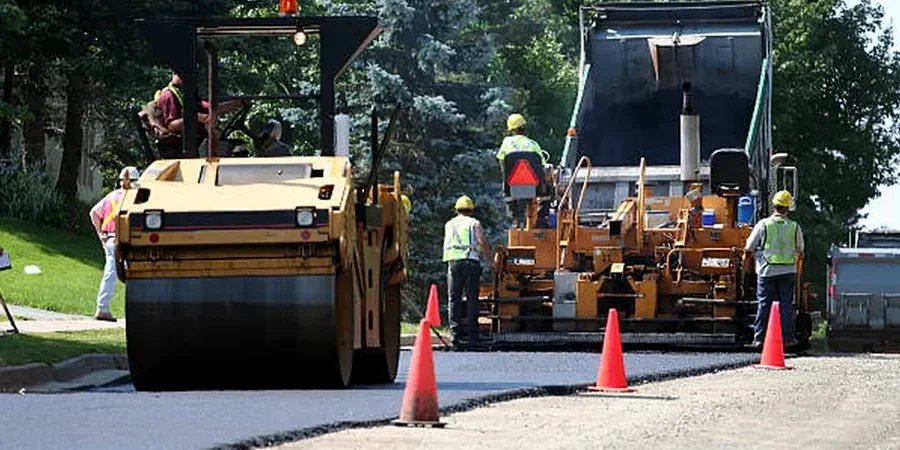
Basing a pavement spec on Toronto or Mississauga data is a fast track to premature failure in Thunder Bay. We have pulled cores from parking lots near the waterfront where the base course was completely saturated before the first freeze-thaw cycle, simply because the drainage layer was designed without accounting for the local silty clay subgrade. Flexible pavement engineering here means confronting a 1,400 mm frost depth, aggressive spring breakup conditions, and the brutal axle loads from grain haulers and logging trucks on arterial roads like the Harbour Expressway. We design granular structures that hold their modulus when the subgrade thaws, and we specify asphalt binders that resist thermal cracking at minus 35 degrees. Our team works directly with contractors across the district, from the Intercity area to rural Oliver Paipoonge, applying the CBR testing protocols that give us the subgrade strength values we need before a single layer of stone is placed. The numbers have to be local, not borrowed from southern Ontario tables, because the lacustrine deposits here behave very differently under repeated loading.
A pavement designed without local frost-depth data will heave unevenly and crack in its first winter — the repair costs far outweigh the upfront saving of skipping a subgrade investigation.
Process and scope
With a population nearing 110,000 and a municipal road network that covers over 1,200 lane kilometers, Thunder Bay's pavement budget demands designs that minimize life-cycle costs. We use the AASHTO 1993 mechanistic-empirical framework, calibrated to Ontario's specific climate and traffic data, to optimize the thickness of hot mix asphalt, granular base, and subbase layers. A typical heavy-duty section we deliver for a truck terminal on Walsh Street might call for a 140 mm HMA surface course over 250 mm of 19 mm crushed stone, but only after we verify the resilient modulus of the underlying till. Our lab runs repeated load triaxial tests on locally sourced aggregates to avoid the premature rutting we have seen in industrial yards that used uncrushed river gravel. The key output is a pavement structure that drains fast, flexes just enough under load, and resists the longitudinal cracking that plagues roads built on the compressible silts found along the Kaministiquia River floodplain.
Site-specific factors
Thunder Bay's urban development spread rapidly after the 1970 amalgamation, pushing roads and industrial parks onto poorly drained lacustrine plains that were never compacted for modern truck loads. The risk in flexible pavement design on these sites is not just rutting — it is a complete loss of structural support during the spring thaw, when trapped water turns the upper 600 mm of subgrade into a slurry. We have investigated failures on Dawson Road where the asphalt had less than 3% air voids, causing moisture damage and stripping of the aggregate within five years. A pavement that cannot breathe and drain will fail early, no matter how thick the asphalt mat. Our risk assessment focuses on crossfall design, edge drainage, and the capillary break function of the open-graded base layer. In areas with high groundwater, we specify subdrain systems that intercept flow before it reaches the pavement structure, because once a base course becomes saturated, its modulus drops by half, and that is when alligator cracking begins.
Common questions
What does a flexible pavement design package cost in Thunder Bay?
Budget between CA$2,570 and CA$8,140 for a complete design package, depending on the length of the roadway and the number of soil investigation points required. A short commercial driveway with one borehole falls at the lower end, while a multi-lane arterial with five-day traffic data runs higher.
How do you determine the asphalt binder grade for Thunder Bay's winters?
We select the performance grade based on the lowest anticipated pavement temperature, which routinely drops below minus 35 degrees Celsius in Thunder Bay. This typically leads us to specify a PG 58-34 or PG 58-40 binder, tested under AASHTO M 320, to resist thermal contraction cracking.
Why do roads in Thunder Bay get so many potholes after the spring thaw?
Potholes form when water trapped in the pavement structure freezes and expands, then thaws, leaving voids. In Thunder Bay, the deep frost penetration and slow drainage of silty subgrades accelerate this process. A properly designed granular base with an effective drainage path is the primary defense.
What is the minimum CBR value you require for a commercial parking lot?
We target a minimum soaked CBR of 6% for commercial lots that will see regular truck traffic. If the native soil does not meet this, we design a granular replacement or stabilization layer to bridge the weak subgrade and protect the asphalt from flexural fatigue.