← Home · Laboratory

Laboratory CBR Testing in Thunder Bay

Together, we solve the challenges of tomorrow.

LEARN MORE →

Thunder Bay sits on a complex foundation of glaciolacustrine clay and silty till, remnants of Lake Agassiz that still influence every road built here. The silts can pump water under load, and the clays lose strength fast when saturated. A standard Proctor tells you density—it doesn’t tell you how the soil behaves under repeated traffic. That’s where the laboratory CBR test becomes essential. By measuring penetration resistance at controlled moisture and density, we quantify the bearing capacity your subgrade will actually deliver after compaction. For deep clay deposits common near the Kaministiquia River floodplain, we often pair the lab CBR with a field CBR test to verify that compaction in the cut matches the laboratory curve, and with a grain size analysis to confirm the fines content driving the low soaked strength.

A soaked CBR value below 3% in Thunder Bay’s glaciolacustrine silts means your pavement structure needs a full subgrade replacement or chemical stabilization—no amount of extra asphalt will fix it.

Process and scope

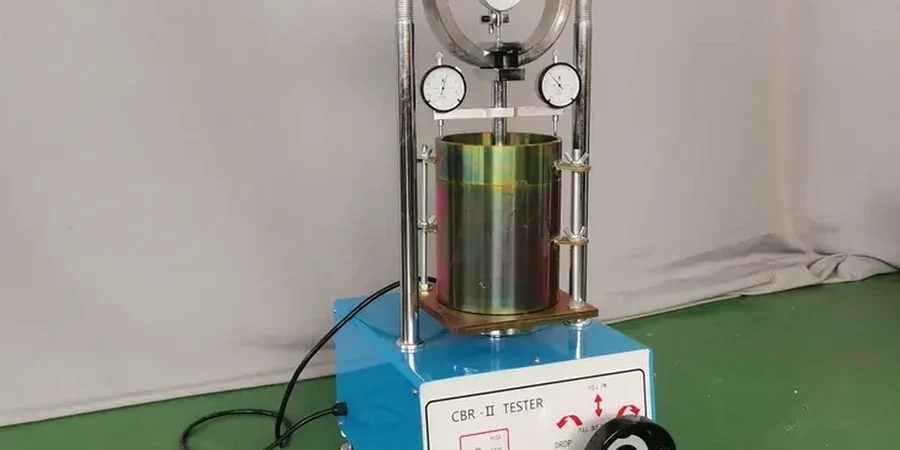
Freeze-thaw cycles dominate pavement performance in Thunder Bay. A subgrade that tests at 12% CBR in September can drop below 3% during spring breakup when ice lenses melt and trapped water can’t drain through the dense basal till. We run the laboratory CBR test strictly following ASTM D1883, but we adapt the soaking period and surcharge weight to reflect local conditions: four days of soaking is often not enough for the low-permeability varved clays found near Boulevard Lake. Our technicians compact specimens at optimum moisture from a modified Proctor and then monitor swell daily. The data feeds directly into the AASHTO 1993 pavement design method, which MTO and the City of Thunder Bay still reference for flexible pavement structures. For sites with high organic content in the upper meter, we recommend supplementing the CBR data with an Atterberg limits test to flag plastic silts that will deform before they fail in bearing.
Laboratory CBR Testing in Thunder Bay
Technical reference image — Thunder Bay

Site-specific factors

Thunder Bay’s annual frost penetration reaches 2.1 meters in exposed clay cuts, and the 2022 flood event showed how fast the Neebing-McIntyre floodway can saturate surrounding subgrades. A laboratory CBR test that ignores post-soaking strength reduction is misleading. The biggest risk on Highway 61 and Dawson Road corridors is designing a granular base thickness from an unsoaked CBR that won’t survive the first spring thaw. We’ve seen projects where the difference between soaked and unsoaked CBR exceeded 8 percentage points in varved clay. That gap translates directly into pavement rutting within three freeze-thaw seasons. The Ontario Provincial Standard Specification OPSS 1010 requires soaked CBR values for structural design, and we prepare every report with clear commentary on swell potential and strength loss so your pavement engineer can specify stabilization or a thicker base course without guesswork.

Need a geotechnical assessment?

Reply within 24h.

Email: [email protected]

Video resource

Reference parameters

ParameterTypical value
StandardASTM D1883-21
Compactive effortModified Proctor (ASTM D1557)
Soaking period96 hours (standard); extended soaking available for low-permeability clays
Surcharge weight4.54 kg annular and slotted weights per ASTM; heavier surcharge by request for deep fill sections
Penetration rate1.27 mm/min (0.05 in/min)
Reported valuesCBR at 2.54 mm and 5.08 mm penetration; swell percentage; moisture content before and after soaking
Sample preparationRemolded at optimum moisture content and target density from field cores or bulk samples

Related services

01

Standard Soaked CBR (ASTM D1883)

Three-point compaction and penetration testing with 96-hour soaking under standardized surcharge. Includes swell monitoring, moisture content before and after soaking, and the CBR value at both 2.54 mm and 5.08 mm penetration. Typical turnaround is five business days from sample receipt.

02

CBR with Extended Soaking and Swell Analysis

For low-permeability glaciolacustrine clays and silty tills where four-day soaking does not reach saturation equilibrium. We extend the soak to seven or ten days and record daily swell readings. This data is critical for pavement design on the Lake Superior shoreline and the floodplain south of the Neebing River.

Applicable standards

ASTM D1883-21: Standard Test Method for California Bearing Ratio (CBR) of Laboratory-Compacted Soils, ASTM D1557-12(2021): Standard Test Methods for Laboratory Compaction Characteristics of Soil Using Modified Effort, OPSS 1010 (Ontario Provincial Standard Specification): Material Specification for Aggregates – Base, Subbase, Select Subgrade, and Backfill Material, AASHTO Guide for Design of Pavement Structures, 1993 (referenced by MTO and City of Thunder Bay)

Common questions

How much does a laboratory CBR test cost in Thunder Bay?

A standard soaked CBR test following ASTM D1883 typically runs between CA$190 and CA$270 per point, depending on whether you need a single three-point curve or multiple compaction efforts. The price includes sample prep, compaction, soaking, penetration testing, and the final report. We can provide a firm quote once we know the number of samples and the target density range.

What’s the difference between a lab CBR and a field CBR test?

A lab CBR measures the bearing capacity of a soil compacted to a known density and moisture under controlled conditions, with a standardized soaking period to simulate worst-case saturation. A field CBR tests the subgrade in place after compaction. The lab value gives you the design number; the field test verifies the contractor hit it. For silty subgrades in Thunder Bay, the difference between the two can be large if compaction moisture is off-spec.

How long does the lab CBR test take?

Standard turnaround is five business days: one day for compaction and setup, four days of soaking, and the penetration test on the fifth day. Extended soaking protocols for low-permeability clays add two to five extra days. We can expedite to three days with a surcharge if your project timeline demands it—call us to check current lab capacity.
Location and service area

We serve projects in Thunder Bay and surrounding areas.

View larger map