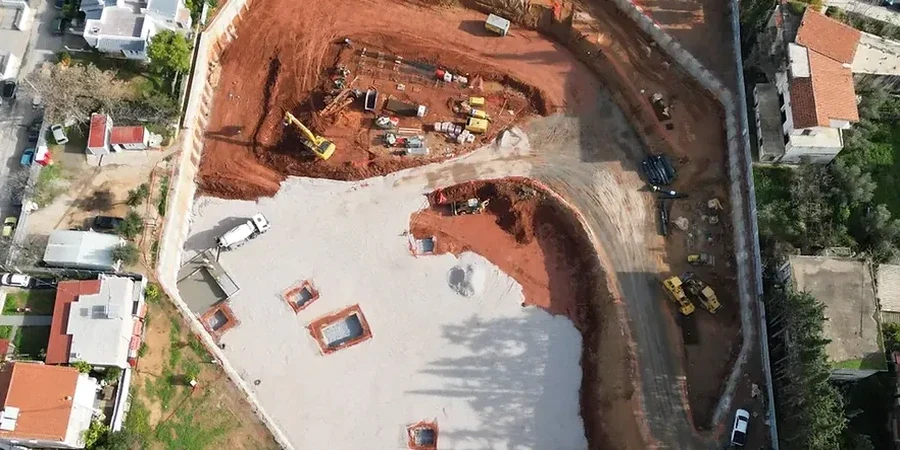
The soil conditions between Port Arthur and Fort William can differ as dramatically as the history of the two former cities themselves. A contractor working near the waterfront in the Intercity area will contend with soft, compressible clays and a high water table influenced by Lake Superior, while a project up toward the bluffs of Current River encounters stiff glacial till overlying the fractured shale of the Rove Formation. This geological diversity means a single, generic excavation shoring plan is a liability. The geotechnical design of deep excavations in Thunder Bay must reconcile these abrupt transitions. We combine local boring data with advanced numerical modeling to predict wall deflection and basal heave, then cross-reference the results with the requirements of the 2020 National Building Code of Canada. Before mobilizing equipment, it is standard practice to ground-truth the stratigraphy by correlating our design parameters with field data from CPT testing, ensuring the shoring system is calibrated to the actual pore pressure and tip resistance encountered on site.
In Thunder Bay’s lacustrine clays, the difference between a successful deep excavation and a costly failure often lies in the pre-construction analysis of undrained shear strength and its sensitivity to remolding.
Process and scope
A common and expensive mistake is assuming that a soldier pile and lagging wall designed for Toronto or Winnipeg will perform identically in Thunder Bay. The local shale is notoriously susceptible to rapid slaking when exposed to air and moisture, which can trigger progressive raveling behind the lagging and create voids that undermine adjacent roads like Memorial Avenue. Our design process addresses this by specifying weathered-rock bond strengths, sealing shotcrete facings, and detailing drainage systems that prevent perched water from accumulating in the annulus. We deliver a complete construction package that includes staged excavation sequences, strut or tieback pre-load values, and groundwater control measures, all verified under CAN/CSA S6 for highway-adjacent cuts or CSA A23.3 for structural concrete components. The result is a shoring system that maintains serviceability limits even during the spring thaw, when a saturated overburden exerts maximum active pressure on the walls.
Site-specific factors
The Thunder Bay region sits within the Lake Superior basin, where the Quaternary stratigraphy is dominated by glaciolacustrine deposits that can host artesian groundwater conditions at depth. A deep excavation that inadvertently punctures a confined aquifer within the interbedded silt and sand lenses can result in a sudden base blowout, destabilizing the entire open cut in minutes. Beyond hydrogeological hazards, the presence of sensitive clay layers means that excessive vibration from nearby blasting or piling can trigger a significant loss of soil strength, a phenomenon well-documented in the literature by Lefebvre and others on Eastern Canadian clays. Our design explicitly addresses these risks through mandatory pore-pressure monitoring, limits on adjacent construction activity during critical excavation stages, and contingency plans for rapid dewatering or base grouting if the inflow exceeds the design threshold.
Common questions
How much does a geotechnical design for a deep excavation in Thunder Bay typically cost?
The engineering fee for a deep excavation design in Thunder Bay generally ranges from CA$2,970 to CA$11,710, depending on the complexity of the shoring system, the depth of the cut, and the number of adjacent structures requiring settlement analysis. A straightforward single-tier tieback wall design on a greenfield site falls at the lower end, while a multi-level strutted excavation next to a sensitive heritage building near downtown will require extensive 3D modeling and instrumentation planning, placing it at the higher end.
What is the biggest geotechnical challenge for deep excavations in Thunder Bay?
Managing the highly variable groundwater regime is the primary challenge. The interface between the glacial till and the underlying fractured shale of the Rove Formation can act as a conduit for water, leading to unexpected inflows. Additionally, the dried crust of the lacustrine clay can give a false impression of strength; once excavated, the softer, saturated clay beneath can exhibit significant creep, requiring solid and timely installation of the lateral support system.
How does the NBCC 2020 seismic requirement affect deep excavation design here?
Although Thunder Bay is in a region of relatively low seismic hazard, the NBCC 2020 still mandates a seismic stability check for excavations that are critical or deeper than 6 meters. The design must account for the dynamic earth pressure increment during a design seismic event, and for the potential degradation of sensitive clay strength under cyclic loading, ensuring that the wall does not undergo excessive permanent displacement.
What type of shoring works best in Thunder Bay’s shale bedrock?
For excavations that extend into the shale, a combination of soldier piles socketed into the rock with a reinforced shotcrete facing is often the most practical and cost-effective solution. The key is to specify a shotcrete mix that cures quickly to prevent the shale from air-slaking. In areas where the rock is highly fractured and the groundwater is aggressive, a secant pile wall provides a more watertight and rigid alternative.