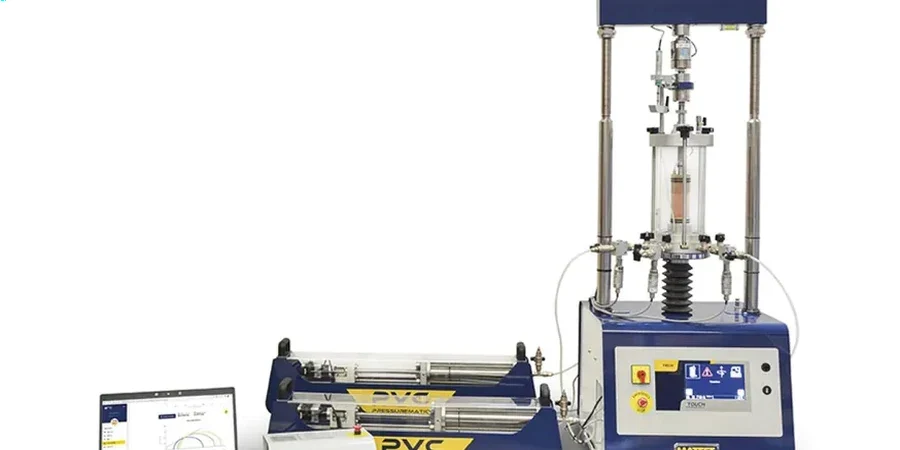
A contractor called us last fall from a site near the Kaministiquia River delta. Soft varved clays everywhere. The borehole logs showed 12 meters of it. They needed drained and undrained strength parameters fast. Foundation design for a six-story structure on that kind of soil is unforgiving. We ran a consolidated-undrained triaxial test with pore pressure measurement. The results changed their footing depth by two meters. Thunder Bay’s post-glacial stratigraphy demands this level of precision. You cannot extrapolate from index tests alone when sensitive clays are present. The CPT test gives continuous profiling, but the triaxial cell is where you measure effective friction angle directly. That is the number the structural engineer needs.
Effective stress parameters from a triaxial test eliminate the guesswork in bearing capacity calculations on Thunder Bay’s varved clays.
Common questions
How much does a triaxial test cost in Thunder Bay?
A standard CU triaxial set with three specimens typically costs between CA$2,560 and CA$3,180. The final price depends on sample preparation time, especially if the material contains large clasts or requires special trimming.
What is the difference between UU, CU, and CD triaxial tests?
UU (unconsolidated-undrained) gives total stress parameters for short-term loading on cohesive soils. CU (consolidated-undrained) measures effective stress parameters with pore pressure monitoring, useful for staged construction. CD (consolidated-drained) is for free-draining soils where long-term drained strength governs design.
How long does it take to get results?
UU tests can be completed in 3-4 business days. CU tests require saturation and consolidation stages, so plan for 7-10 business days. CD tests on fine-grained soils can take two weeks due to the slow shear rate required to prevent pore pressure buildup.
What sample quality do you need for triaxial testing?
We require undisturbed Shelby tube samples for cohesive soils. The tube must be sealed immediately after extraction and kept upright during transport. Samples that have dried out, frozen, or been heavily disturbed during drilling will not yield reliable triaxial results.
Can you test granular soils from the Kam River delta?
Yes, but undisturbed sampling of granular soils is difficult. We typically reconstitute the specimen to the field density you specify. For loose saturated sands prone to liquefaction, we run cyclic triaxial tests under simulated seismic loading conditions per NBCC requirements.