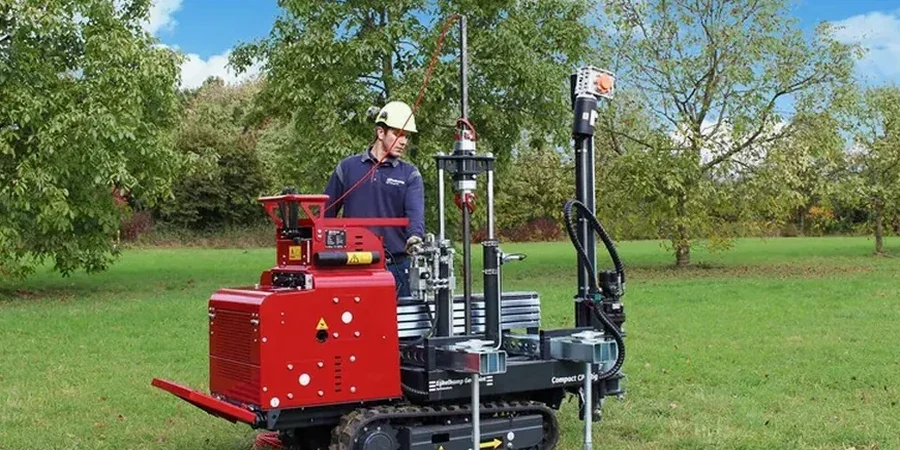
Thunder Bay’s development from a fur trading post into a major Lake Superior port meant building on some of the most challenging glaciolacustrine deposits in Ontario. The city sits on a complex layering of varved clays, silts, and stony tills left by Glacial Lake Agassiz, which can vary drastically within a single block. When the Sleeping Giant looms over a project site, the subsurface rarely tells a simple story. We run the cone penetration test to cut through that ambiguity, providing a continuous electronic log that maps the transition from soft, compressible silts into competent lodgement till. For any engineer working near the Kam River floodplain, where organic lenses are common, we often recommend pairing the CPT profile with a grain size analysis to verify the fines content that controls drainage behavior, or a triaxial test to define the undrained shear strength parameters needed for deep foundation design.
Continuous CPT profiling reveals the thin sand seams in Thunder Bay's varved clays that conventional split-spoon sampling at 1.5-meter intervals almost always misses.
Process and scope
The rig we mobilize across the Canadian Shield margin here is a tracked 20-ton CPT system configured to handle Thunder Bay’s infamous sensitive clays without disturbing the sample. It pushes a 60-degree cone with a 10 cm² or 15 cm² cross-sectional area into the ground at a constant rate of 20 mm/s, while a string of electronic transducers records tip resistance, sleeve friction, and dynamic pore water pressure behind the cone shoulder. Because many sites near Current River contain cobbles embedded in the matrix, we start every sounding with a pre-drilled pilot hole through the upper fill or gravel layer. The data streams in real time to a laptop in the support vehicle, where our operator monitors the friction ratio and pore pressure dissipation curves, which are critical for identifying the thin drainage layers that prevent consolidation settlement in structures founded on the varved clay plains. This direct-push technology lets us complete a 25-meter profile in a morning, even when the Lake Superior windchill drives the ambient temperature well below -20°C, a scenario where conventional drilling fluid management becomes a logistical headache.
Site-specific factors
The extreme temperature swings in Northwestern Ontario, from -35°C in February to +30°C in July, create a unique challenge for mechanical soil testing. In winter, the upper meter of ground freezes solid, and attempting to push a cone through an ice-locked crust without proper pre-drilling can damage the sleeve friction sensor. We see this often on rushed projects near the Intercity district. The more persistent risk, however, is misclassifying the sensitive, low-plasticity silts that collapse structurally when remolded. A standard penetration test can liquefy these soils during the hammer blow, generating artificially low N-values, whereas the CPT’s static push captures the true in-situ state. Ignoring the pore pressure dissipation test after a CPT sounding in these materials can lead to an overestimation of the consolidation coefficient, delaying settlement predictions and forcing costly remedial grouting or stone columns under a foundation that should have been designed with a different bearing stratum.
Common questions
What depth can a CPT rig reach in Thunder Bay's clay soils?
In the soft to firm glaciolacustrine clays and silts typical of the Thunder Bay lowlands, a 20-tonne rig can typically reach 25 to 30 meters before encountering refusal. If the profile hits a dense bouldery till layer at the base of the varved sequence, penetration stops at that interface, which is often exactly what the engineer needs to confirm the top of competent bearing stratum.
How much does a CPT investigation cost for a typical residential lot in Thunder Bay?
For a standard suburban lot where we mobilize a tracked rig and perform two to three soundings to approximately 15 meters depth, the cost generally falls between CA$240 and CA$390 per sounding, depending on access constraints and whether pre-drilling through frozen crust or fill is required.
Is the CPT better than SPT for investigating the sensitive clays found near the Kam River?
The CPT provides a continuous profile and measures pore pressure, which is critical for identifying the thin drainage layers within sensitive varved clays. The SPT, by contrast, provides a disturbed sample every 1.5 meters and can remold the structure of these soils during hammering, potentially masking the true sensitivity. We often use CPT as the primary investigation tool and follow with selective sampling if Atterberg limits or shear strength confirmation is needed.