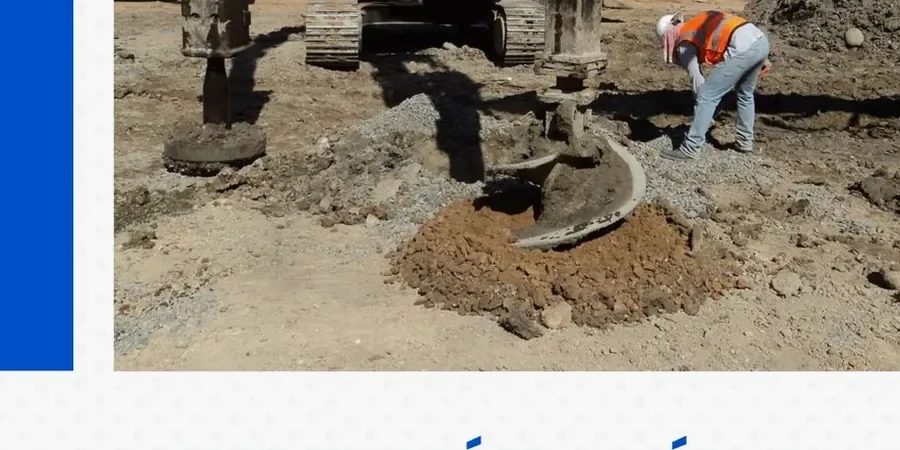
On the north side of Thunder Bay, where the former lakebed of Glacial Lake Agassiz left deep, compressible clay deposits over 25 metres thick, conventional shallow footings rarely provide the performance a project demands. The silty clays and varved sediments that dominate the city's low-lying areas can consolidate unevenly under structural load, making differential settlement the primary engineering concern. Field observations from dozens of local projects confirm that well-designed stone columns redistribute stress through the soft matrix and create drained load paths that accelerate primary consolidation. The design sequence begins with a targeted geotechnical investigation, often combining CPT soundings to map the undrained shear strength profile with depth, and moves into column spacing, diameter, and modulus selection governed by the allowable post-construction settlement specified for the structure. In Thunder Bay's regulatory environment, compliance with the Ontario Building Code and CSA A23.3 is non-negotiable, and every design package we prepare includes bearing capacity verification and a settlement-time curve calibrated to the site-specific preconsolidation pressure measured in the lab.
A stone column grid designed for 25 mm of total settlement in Thunder Bay clay behaves fundamentally differently than one designed for 50 mm; the area replacement ratio changes nonlinearly with the settlement target.
Site-specific factors
The contrast between a site in Current River, where the clay thins to less than 6 metres over bedrock, and one in Intercity, where the compressible layer can exceed 30 metres, illustrates why a generic stone column specification fails in Thunder Bay. In Current River, the columns may bear near refusal on the underlying till, and the design is controlled by the bulging failure mode near the column head. In Intercity, the columns float in the clay mass, and the settlement of the entire reinforced block must be checked against the compressibility of the deeper, unimproved strata. The most expensive risk on these deep-clay sites is underestimating the post-construction secondary compression settlement: even after primary consolidation completes, the organic silt lenses common in the Thunder Bay Formation continue to creep under sustained load. A design that ignores this can produce a structure that meets the one-year settlement criterion but tilts gradually over the next decade. We address this by running consolidation tests on undisturbed Shelby tube samples from the full depth of the compressible profile and incorporating the secondary compression index into the long-term settlement projection for the stone column reinforced ground.
Common questions
What geotechnical data is needed to start a stone column design for a Thunder Bay site?
The minimum dataset includes a CPT or SPT profile extending to the competent till, laboratory consolidation tests on undisturbed clay samples from at least three depths, undrained shear strength from field vane or triaxial UU tests, and groundwater level monitoring. For sites with more than 15 metres of soft clay, we also recommend a piezocone dissipation test to estimate the horizontal coefficient of consolidation, which controls the rate of settlement after column installation.
How long does the detailed design phase take for a typical commercial building?
For a building footprint under 2,000 square metres with complete geotechnical data already available, the detailed design memorandum and construction drawings are typically completed within three to four weeks. Sites requiring supplementary field investigation or complex finite element calibration may extend the timeline by an additional one to two weeks.
What is the typical cost range for stone column design on a Thunder Bay project?
The design fee for a stone column foundation improvement package in Thunder Bay generally falls between CA$1,810 and CA$6,940, depending on the building footprint, the complexity of the soil profile, and the level of numerical modelling required. A straightforward single-storey structure on moderately thick clay sits at the lower end, while a multi-storey building on deep, highly compressible clay with a rigid raft connection and full FE calibration falls at the upper end.
Can stone columns be designed to reduce liquefaction risk under the NBCC seismic provisions?
Yes, stone columns act as drains during cyclic loading and can densify the surrounding granular soils when installed by vibro-replacement. For Thunder Bay sites classified as Site Class E or F under NBCC 2015, the design includes a liquefaction triggering analysis and a check on the excess pore pressure dissipation time relative to the earthquake duration. The column spacing is adjusted to achieve the target factor of safety against liquefaction.
What quality control tests are specified after stone column installation?
The standard verification program includes a zone load test on at least one column per 5,000 square metres of treated area, along with modulus verification using a plate load test on a representative column group. For critical structures, we also specify cross-hole seismic testing between columns to confirm the shear wave velocity increase in the treated soil mass. All test results are compared against the design acceptance criteria defined in the construction specifications.