Thunder Bay’s development, from its roots as a fur trade amalgamation of Fort William and Port Arthur to its current role as a Lake Superior shipping hub, has always contended with a challenging geological inheritance. The city sits atop the rugged Precambrian bedrock of the Canadian Shield, draped in a discontinuous blanket of glacial till, lacustrine clays left by Glacial Lake Agassiz, and soft organic deposits in low-lying areas. This erratic subsurface, where competent granite can plunge beneath thirty feet of compressible silty clay within the span of a single residential lot, makes generalized geotechnical assumptions risky. An exploratory test pit provides the most direct method to observe these transitions, allowing our technical team to log the actual soil fabric, measure the depth to bedrock refusal, and identify groundwater seepage zones that borehole samples often miss. This visual confirmation is critical before finalizing foundation designs or planning excavation support in the city’s varied terrain.
Seeing the stratigraphy in full-scale profile at the pit wall often reveals critical discontinuities that a 2-inch core sample could never capture.
Process and scope
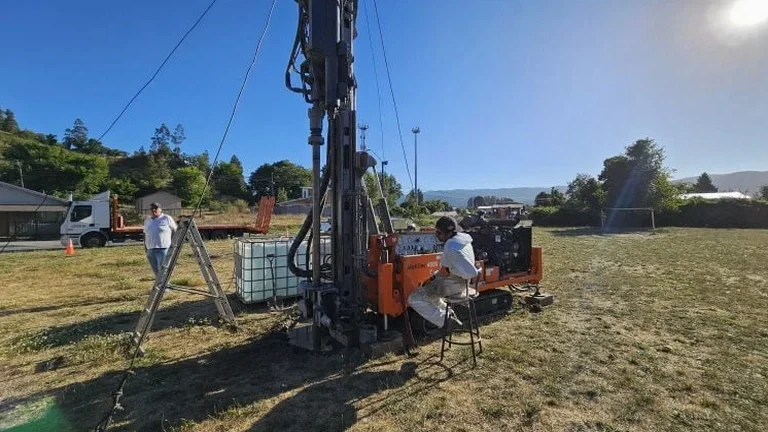
The backbone of our field operation in Thunder Bay relies on a fleet of compact hydraulic excavators, typically 3.5 to 5-tonne units, chosen specifically because they can access tight urban backyards in neighborhoods like Current River without excessive disturbance, yet still achieve probing depths of 4 to 5 meters in competent till. The real diagnostic work, however, happens at the pit face. Our senior geologists descend into the excavation—properly shored and ventilated per Ontario Regulation 213/91—to take undisturbed block samples of sensitive Leda-type clays, perform pocket penetrometer readings on exposed granular seams, and collect bulk samples sealed immediately in polyethylene bags to preserve natural moisture content. This approach proves particularly telling when crossing the complex contact zone between the Gunflint Formation sedimentary rocks and the massive granitic intrusions that characterize the local ridge systems. When soft compressible layers are identified, we often recommend supplemental investigation through an SPT drilling program to quantify bearing resistance at depths beyond the reach of a standard test pit.
Site-specific factors
A recurring observation in Thunder Bay’s older neighborhoods is the presence of undocumented backfill, often containing sawmill waste, wood debris, and cinder from the railway era, hidden beneath a thin crust of grass. Test pits are the only sure way to uncover these pockets, which tend to settle differentially and create a corrosive environment for buried concrete. The immediate risk on site is the instability of saturated silts at the pit base, particularly near the Kaministiquia River delta where artesian pressures can cause a sudden boil-up and flooding of the excavation. Our field supervisors enforce a strict protocol: no entry into any pit deeper than 1.2 meters without a properly engineered trench box or battered back-slope of at least 1:1 in Type 3 soil, in accordance with the Occupational Health and Safety Act (OHSA) requirements for construction projects in Ontario.
Reference standards
NBCC (National Building Code of Canada) Division B, Part 4, CSA A23.3: Design of Concrete Structures, OPSS.MUNI 206: Grading, Excavating, Backfilling, and Compacting, Ontario Regulation 213/91: Construction Projects
Common questions
What are the typical costs for an exploratory test pit in Thunder Bay?
Based on current local mobilization rates, typical access conditions, and a standard single-day program, exploratory test pit investigations in Thunder Bay generally range from CA$610 to CA$1,220. The final cost depends on the number of pits, their depth, the need for traffic control on city streets, and whether laboratory testing of the recovered samples is included in the scope of work.
How close to an existing building can you excavate a test pit?
We follow the guideline that the bottom of the excavation must not extend below a 1:1 line projected upward from the foundation base, unless a specific shoring design is implemented. In practical terms for Thunder Bay, this often means keeping the pit edge at least 1.5 to 2 meters away from a typical residential footing in clay soil to avoid undermining.
Are test pits safe in the soft clay soils common near the lake?
Safety is the primary concern in the sensitive lacustrine clays found around the Thunder Bay harbour. We classify the soil according to Ontario Reg. 213/91 and, for Type 3 or 4 soils, we step back the walls to a stable angle or install a certified trench box before any personnel enter the pit for sampling.
What are the advantages of a test pit compared to a borehole for a residential addition?
For home additions, a test pit allows the geotechnical engineer to visually inspect the exact contact between the footing and the native soil, identify any organic topsoil trapped by previous construction, and see the actual cobble content in the till—something a standard borehole log often smooths over as generalized 'sand and gravel'.
How do you restore the site after completing the test pit?
We backfill the excavation in controlled lifts, typically 200 mm thick, compacting each layer with a vibrating plate tamper to match the density of the surrounding undisturbed material. The surface is then graded to promote positive drainage away from structures, and if required by the city permit, we restore sod or asphalt patching to the original condition.