Geotechnical Engineering in Thunder Bay

Together, we solve the challenges of tomorrow.

LEARN MORE →

Thunder Bay sits at an elevation of about 199 meters above Lake Superior, right where the Canadian Shield meets the lacustrine clay plains. That physical fact alone means developers here deal with a Jekyll-and-Hyde subsurface: dense till and bedrock on one lot, and soft, compressible silty clay on the next. A proper soil mechanics study in Thunder Bay is not paperwork. It is the only way to predict how the ground will behave under load, freeze-thaw cycles, and drainage changes over a thirty-year building life. We see too many foundation surprises that could have been avoided with a test pits program early in the design phase. Our lab runs index and strength tests under CSA and ASTM protocols so the numbers you get are defensible with the city and your insurer. In a place where winter can push frost three meters deep, the soil mechanics study has to account for seasonal extremes that engineers in Toronto or Vancouver rarely think about.

In Thunder Bay, frost action and varved clays can turn a textbook foundation design into a real headache if the soil mechanics study does not capture seasonal behavior.
Geotechnical Engineering in Thunder Bay
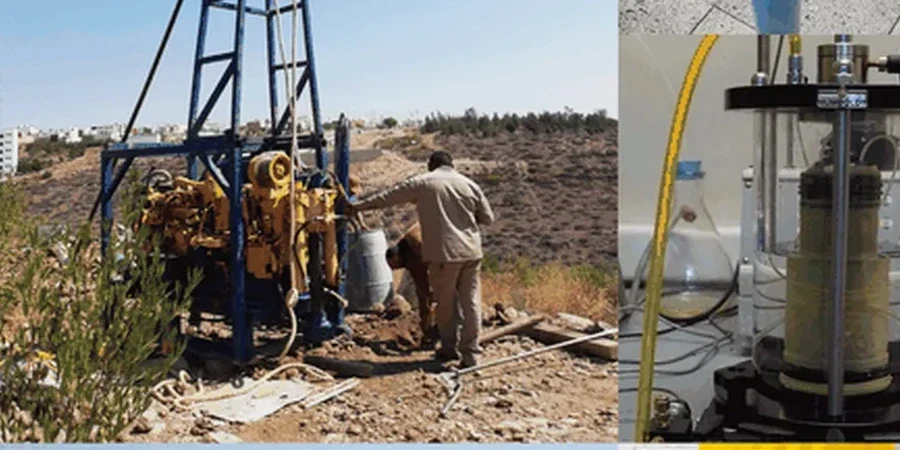
Technical reference image — Thunder Bay

Process and scope

One thing we notice repeatedly in Thunder Bay is the presence of varved clays in the lower Kaministiquia River corridor. These soils look uniform in a hand sample but behave anisotropically under stress because of seasonal silt-clay layering. A soil mechanics study here has to go beyond basic classification. We typically combine Atterberg limits with consolidated-undrained triaxial testing to capture the real shear strength, especially when the project involves deep excavations near the waterfront. In our experience, a CPT test complements the lab program nicely for profiling these sensitive silts without disturbing the fabric. And because much of the city’s expansion is happening on former rail yard or industrial fill, we often run grain size analyses to spot debris, slag, or hydrocarbon staining that standard borehole logs might miss. The goal is always a ground model you can rely on when the excavator bucket hits something unexpected.

Site-specific factors

The National Building Code of Canada (NBCC 2015) and CSA A23.3 set the performance bar for foundations, but in Thunder Bay the code’s generic site class assumptions can be dangerously optimistic if the soil mechanics study is incomplete. Varved clays in the lake plain have produced differential settlements exceeding 50 mm over a building footprint when preloading was skipped. Frost heave in silty fill can lift unheated slabs by 30 to 60 mm in a single winter. And because Thunder Bay sits in a moderate seismic zone (NBCC seismic hazard values around 0.08–0.12 for Sa(0.2)), the soil mechanics study must also feed into site classification for earthquake design, especially for school and hospital projects. We have seen contractors try to cut the investigation budget and end up with a foundation that passes inspection but cannot handle the long-term creep and cyclic loading that our climate and geology impose. A lean scope costs more later.

Need a geotechnical assessment?

Reply within 24h.

Email: [email protected]

Reference parameters

ParameterTypical value
Standard lab suiteMoisture content, Atterberg limits, grain size distribution (sieve + hydrometer)
Shear strength testingCU triaxial or direct shear per ASTM D4767 / D3080
Consolidation characteristicsOne-dimensional consolidation (oedometer) per ASTM D2435 for settlement prediction
Frost susceptibility screeningBased on grain size and fines content (per CSA guidelines)
Chemical aggressivenessSulfate content, pH, resistivity for concrete durability assessment
Unit weight range (local)Silty clays: 17.5–19.2 kN/m³; Glacial till: 21.0–22.8 kN/m³
Typical LL/PI range (varved clay)Liquid limit 38–62%, Plasticity index 12–30% depending on silt fraction
Reporting formatGeotechnical data report with interpreted parameters per NBCC 2015 requirements

Related services

01

Soil Index and Classification Testing

Grain size, Atterberg limits, and organic content determination to classify soils per the Unified Soil Classification System (USCS). Essential for frost susceptibility screening in Thunder Bay.

02

Shear Strength and Consolidation

Triaxial and direct shear testing to define drained and undrained strength envelopes, plus oedometer tests for settlement analysis in compressible clay zones near the Kaministiquia River.

03

Chemical and Durability Assessment

Soil pH, sulfate content, and electrical resistivity to evaluate concrete and steel corrosion risk, particularly relevant on former industrial sites around the Port of Thunder Bay.

04

Interpretative Geotechnical Report

We compile lab results with field logs to produce bearing capacity, settlement, and lateral earth pressure parameters ready for your structural engineer.

Applicable standards

NBCC 2015 (National Building Code of Canada) – structural design and site classification, CSA A23.3 – Design of concrete structures, durability exposure classes, ASTM D4767 – Consolidated-Undrained Triaxial Compression Test for Cohesive Soils, ASTM D2435 – One-Dimensional Consolidation Properties of Soils, ASTM D3080 – Direct Shear Test of Soils Under Consolidated Drained Conditions

Common questions

How much does a soil mechanics study cost for a typical single-family home lot in Thunder Bay?

For a residential lot in Thunder Bay, a soil mechanics study that includes a test pit, laboratory classification, and a short foundation recommendation letter usually runs between CA$4,470 and CA$6,390, depending on access and the number of samples tested. If we need to add consolidation or triaxial testing because of soft clays, the lab scope increases accordingly. We always provide a fixed scope and price before mobilizing.

What makes Thunder Bay soils different from southern Ontario soils?

The biggest difference is the mix of Precambrian Shield bedrock and glaciolacustrine sediments. In many parts of the city you get stiff silty till and bedrock at shallow depth, but in the lowlands you encounter varved clays and silts deposited by glacial Lake Agassiz. Those varved soils can be sensitive and prone to anisotropic behavior, which means lab testing here needs to look at more than just undrained shear strength.

Do I need a soil mechanics study for a small addition or a deck in Thunder Bay?

Even for a deck or a sunroom addition, the City of Thunder Bay’s building department often requires a foundation condition letter from a qualified geotechnical firm. A shallow test pit and basic lab work can confirm bearing capacity and frost protection requirements. It is a small investment compared to fixing frost-heaved footings or a settled slab after one winter.

How long does it take to get the lab results and final report?

Standard classification and shear strength tests typically take two to three weeks from sample arrival. Consolidation tests add about one week because of the incremental loading schedule. We can usually deliver a preliminary letter with bearing recommendations within ten business days if the project schedule is tight.
Location and service area

We serve projects in Thunder Bay and surrounding areas.

View larger map